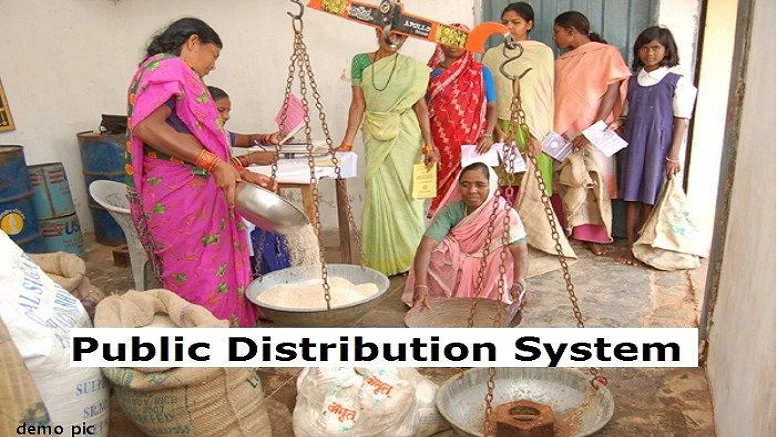
If you have ever visited a ration shop in a village or small town, you’ll notice something simple but powerful people waiting quietly with their ration cards.
For many households, that monthly ration is not just wheat or rice.
It is certainty.
It means food will be cooked at home. It means children will not sleep hungry. It means expenses are manageable for another month.
That is what the Public Distribution System (PDS) represents in real life.
On paper, it is described as a government system for distributing essential commodities at subsidized prices. But beyond the official definition, it is one of the largest food security programs in the world.
Let’s understand it properly not as an exam topic, but as something that impacts everyday lives.
What Is the Public Distribution System?
The Public Distribution System is a food security mechanism operated by the Government of India along with state governments.
Under this system:
- The government purchases food grains from farmers.
- These grains are stored safely.
- They are distributed to eligible families at subsidized rates through fair price shops (ration shops).
The goal is simple ensure that no one goes hungry because they cannot afford food.
The main food grains distributed include:
- Rice
- Wheat
- Sugar (in some states)
- Kerosene (earlier more common)
Today, the system mainly focuses on food grains.
Why Was PDS Introduced?
After independence, India faced serious food shortages. Poverty levels were high, and agricultural production was not stable.
Food security became a national priority.
The government needed a structured system to:
- Support farmers through assured procurement.
- Protect poor households from high market prices.
- Ensure food availability even during shortages.
Over time, this structure evolved into what we now call the Public Distribution System.
It was not created overnight. It developed gradually based on the country’s needs.
How the Public Distribution System Works?
Let’s break it down step by step in simple terms.
1. Procurement of Food Grains
The government purchases wheat and rice from farmers at a Minimum Support Price (MSP).
This ensures:
- Farmers get assured income.
- The government builds buffer stocks.
The Food Corporation of India (FCI) plays a major role here.
2. Storage
The procured grains are stored in warehouses across the country.
Storage is important because:
- Grains need to be protected from moisture and pests.
- Stock should be available for distribution throughout the year.
3. Allocation to States
The central government allocates food grains to states based on:
- Population
- Number of eligible beneficiaries
4. Distribution Through Fair Price Shops
States distribute grains through a network of ration shops.
Beneficiaries receive their allotted quantity every month at subsidized prices.
That’s the basic chain procurement, storage, allocation, and distribution.
Targeted Public Distribution System (TPDS)
Earlier, the system was more universal. Over time, it was redesigned to target specific groups.
The Targeted Public Distribution System (TPDS) categorizes families based on economic conditions.
There are mainly two groups:
- Priority households
- Antyodaya Anna Yojana (AAY) households (poorest of the poor)
Under the National Food Security Act (NFSA), eligible individuals receive:
- 5 kg of food grains per person per month
- AAY households receive 35 kg per household per month
This shift helped focus resources on the most vulnerable sections.
National Food Security Act and PDS
The National Food Security Act strengthened the Public Distribution System.
It made food access a legal right for a large section of the population.
This means:
Eligible beneficiaries have a legal entitlement to receive food grains at subsidized rates.
The prices under NFSA are highly subsidized compared to market prices.
This has significantly expanded coverage across the country.
Who Is Eligible for PDS?
Eligibility is decided by state governments based on central guidelines.
Generally, the following categories are covered:
- Low-income families
- Labourers
- Rural poor
- Urban poor
- Vulnerable groups
Each beneficiary receives a ration card.
Types of ration cards may differ from state to state.
Reforms in the Public Distribution System
Over time, several reforms were introduced to improve transparency and reduce leakages.
Digitization of Ration Cards
Duplicate and fake ration cards were a major issue earlier.
Digitization helped:
- Clean beneficiary lists
- Improve accuracy
- Reduce fraud
Aadhaar Seeding
Linking ration cards with Aadhaar improved identity verification.
ePOS Machines
Electronic Point of Sale machines are installed in many ration shops.
These machines:
- Record transactions digitally
- Reduce manual errors
- Increase transparency
One Nation One Ration Card
This reform allows beneficiaries to collect ration from any location in India.
This is especially useful for migrant workers.
Earlier, ration access was restricted to one location. Now portability has improved flexibility.
Importance of PDS in Rural India
In rural areas, income can be seasonal and unpredictable.
During droughts, crop failure, or unemployment, families rely heavily on subsidized food grains.
PDS acts as a safety net.
It reduces:
- Extreme hunger
- Financial stress
- Nutritional insecurity
For many households, it covers a major part of monthly food consumption.
Importance During Crisis
During economic disruptions and emergencies, the Public Distribution System becomes even more important.
For example:
- During pandemics
- During natural disasters
- During economic slowdowns
Additional free food grain distributions have been provided through the PDS network.
This shows how important this infrastructure is during emergencies.
Challenges in the Public Distribution System
While PDS plays a crucial role, it also faces challenges.
Leakage and Diversion
Earlier, food grains were sometimes diverted before reaching beneficiaries.
Reforms have reduced this issue, but monitoring is still important.
Inclusion and Exclusion Errors
Some deserving families may be left out.
Some non-eligible households may get included.
Updating beneficiary lists regularly is essential.
Storage Issues
Proper storage infrastructure is required to prevent wastage.
Quality Concerns
In some areas, complaints about grain quality have been reported.
Continuous monitoring is needed to maintain standards.
PDS vs Direct Cash Transfer Debate
There is an ongoing discussion about whether food subsidies should be replaced with direct cash transfers.
Arguments for cash transfers:
- Flexibility for beneficiaries
- Reduced logistics
Arguments for PDS:
- Ensures food availability
- Protects against inflation
- Guarantees food security
Currently, India continues to strengthen the Public Distribution System while improving efficiency.
Why PDS Still Matters in 2026?
Even though the economy has grown, income inequality still exists.
For low-income households:
Food expenses form a large part of total spending.
Subsidized grains help families:
- Save money
- Spend on education
- Manage medical expenses
It may not eliminate poverty, but it reduces its severity.
Real-Life Example
Consider a daily wage labourer earning a modest income.
If market prices for rice and wheat rise sharply, monthly food expenses increase significantly.
But under PDS:
Food grains are available at subsidized prices.
This stabilizes household expenses.
It creates financial breathing space.
Impact on Farmers
PDS is not only about consumers.
It also supports farmers through procurement at Minimum Support Price.
This ensures:
- Assured demand
- Price stability
- Income support
So the system balances both sides production and distribution.
Role of Technology in Strengthening PDS
Technology has transformed the system significantly.
- Online monitoring
- GPS tracking of transport vehicles
- Digital stock management
- Online grievance redressal
These reforms have increased accountability.
Transparency builds trust.
Frequently Asked Questions (FAQs)
1. What is the Public Distribution System?
The Public Distribution System is a government-run system that distributes essential food grains at subsidized prices to eligible families through ration shops.
2. Who is eligible for PDS benefits?
Eligibility is decided by state governments. Generally, low-income and vulnerable households are covered under the National Food Security framework.
3. What is the National Food Security Act?
The Act provides legal entitlement to subsidized food grains for eligible beneficiaries.
4. How much food grain is provided under PDS?
Eligible individuals receive 5 kg per person per month. Antyodaya households receive 35 kg per household per month.
5. What is One Nation One Ration Card?
It allows beneficiaries to collect ration from any state in India, improving portability for migrant workers.
6. How has technology improved PDS?
Digitization, Aadhaar linking, and ePOS machines have improved transparency and reduced leakages.
7. Is PDS important today?
Yes. It continues to provide food security and financial support to millions of households.
Final Thoughts
The Public Distribution System is often discussed in policy debates and exam papers.
But beyond reports and statistics, it plays a direct role in everyday life.
For millions of families, it means stability.
For farmers, it means assured procurement.
For the country, it represents a large-scale food security framework.
The system is not perfect. No system at this scale can be.
But reforms, technology, and monitoring have strengthened it over time.
Food security remains a foundation of social stability.
And the Public Distribution System continues to serve that foundation.
If you found this guide helpful:
- Share it with someone preparing for competitive exams.
- Share it with someone who wants to understand how ration systems work.
- Stay updated with detailed government scheme guides.
For more simplified explanations of important government schemes and policies, visit:
Stay informed. Stay aware. Make better decisions.
Also Read:
PM Awas Yojana 2026
Punjab Police Recruitment 2026
Punjab ₹1000 Women Scheme 2026
Pradhan Mantri Jeevan Jyoti Bima Yojana (PMJJBY)
UPSSSC Excise Constable Recruitment 2026
Indian Bank SO Recruitment 2026
Indian Army NCC Special Entry 124th October Course 2026
AIIMS Junior Assistant Recruitment 2026 India
Indian Navy SSR Medical Branch Recruitment 2026
Stock Markets Crash as US–Iran Talks Collapse
Airport Security Staff Jobs 2026
Aadhaar Operator Recruitment 2026
About The Author