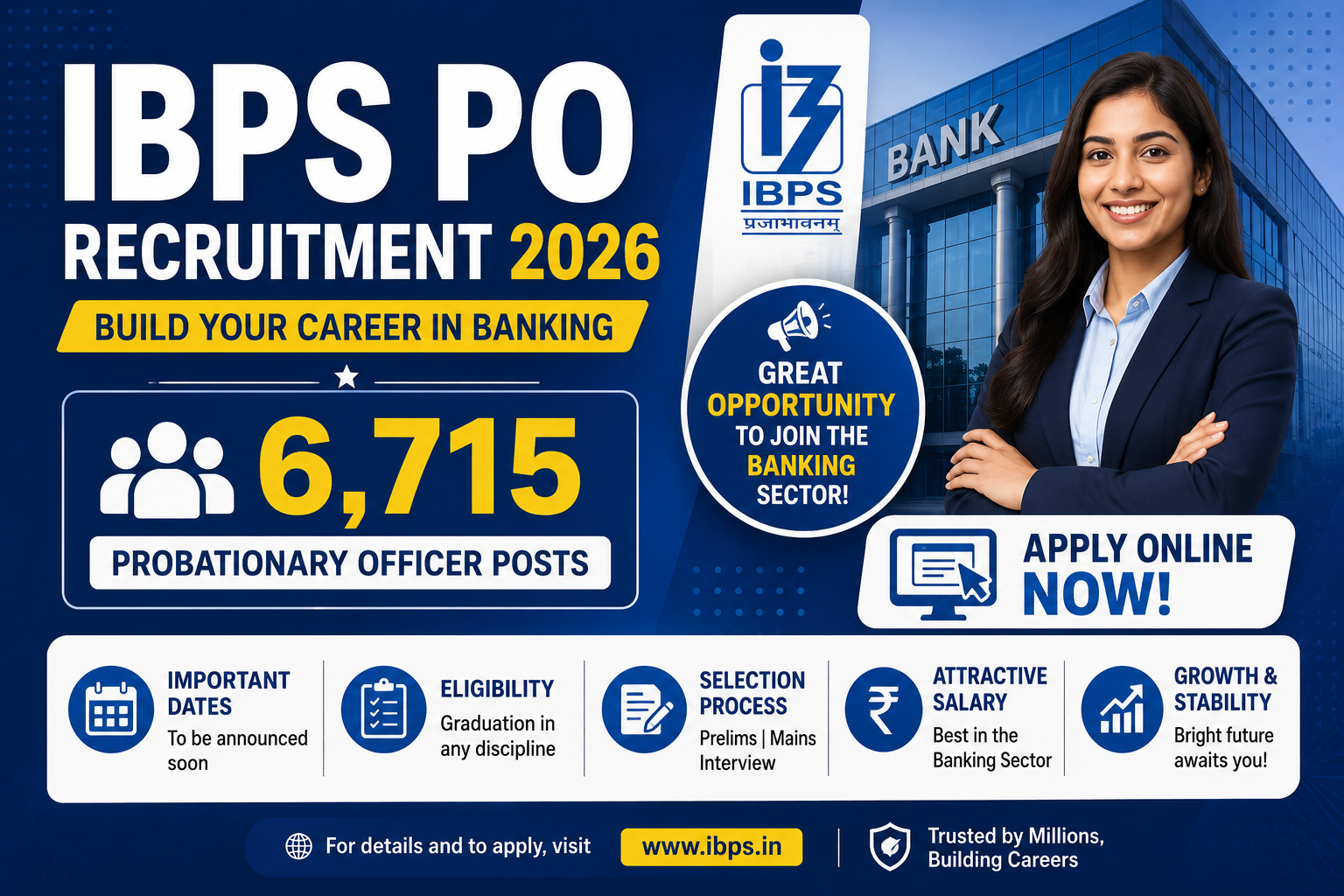
The Institute of Banking Personnel Selection, also known as IBPS, has come out with a notification about the Probationary Officer position for the year 2026. The number of jobs is really big. 6,715 Vacancies. This is a lot more than the number of jobs they had time for, almost 1,500 more. If you are someone who wants to work in a bank or if you are just thinking about it, you should really look at this opportunity. The IBPS Probationary Officer position is a chance for people who want a career in banking.
This isn’t just the notification rewritten with a few extra adjectives. It’s meant to actually walk you through what the PO role involves day to day, who’s eligible, how the selection process works stage by stage, and maybe more usefully where applicants usually mess up and how to avoid doing the same.
Recruitment Overview
| Detail | Information |
|---|---|
| Recruiting Organisation | Institute of Banking Personnel Selection (IBPS) |
| Post Name | Probationary Officer / Management Trainee (CRP PO/MT-XVI) |
| Total Vacancies | 6,715 (indicative, across 11 public sector banks) |
| Application Mode | Online, at ibps.in |
| Job Type | Permanent, officer-level position |
| Job Location | Any participating public sector bank branch across India |
| Selection Process | Prelims, Mains, Personality Test, Interview |
| Official Website | www.ibps.in |
What Does a Probationary Officer Actually Do?
It’s not just a desk job with a fancy title. A PO handles customer queries, processes loan applications, manages daily cash and branch operations, and, increasingly, keeps an eye on digital banking compliance too. Early postings often rotate you through different departments deliberately so you understand the branch as a whole before settling into a specialization.
When you get a promotion at the bank, you usually start as a PO. Then you become an assistant manager. After that you can become a manager. Then you can keep moving up from there. The thing is, how fast you move up really depends on the bank you are working at how well you do your job and how you do on the exams that you have to take along the way. This is a career that has a plan, for the long term, it is not just a job that you have when you first start out.
Vacancy Details
The Bank of Baroda and other banks have a lot of job openings now. There are 6,715 vacancies in total at the Bank of Baroda, Bank of India, Bank of Maharashtra, Canara Bank, Central Bank of India, Indian Bank, Indian Overseas Bank, Punjab National Bank, Punjab & Sind Bank, UCO Bank, and Union Bank of India. These numbers are not final. The banks can change who people they want to hire as time goes on. So this is a chance to get a job, but it is not for sure. If you want to know how many jobs are available in each category you should look at the notifications from the Bank of Baroda and the other banks. Do not trust the numbers you see online because they might not be right. The Bank of Baroda and the other banks are the ones who can give you the information.
Eligibility Criteria
Educational Qualification: You need to have a graduate degree in any subject from a university that is recognized. The result of your graduation degree should be declared on or before the date that you can register for this. The graduation degree can be in any discipline. It must be from a recognized university.
Age Limit: The age limit is between 20 and 30 years old. This is based on the reference date that was given. To give you an idea, people who were born between July 1996 and July 2006 can apply. However, you should really check the notification for the dates. The age limit is for people between 20 and 30 years old, so make sure to check the notification for the birth dates, which are between July 1996 and July 2006.
Age Relaxation: Age Relaxation is available for people who are Scheduled Caste, Scheduled Tribe, Other Backward Class, Persons with Benchmark Disabilities, and ex-servicemen. This rule is followed as per the rules of the government. Age relaxation for Scheduled Caste, Scheduled Tribe, Other Backward Class, Persons with Benchmark Disabilities, and ex-servicemen categories is given to help them.
Nationality: Nationality is something that’s very important. To be considered, you need to be a citizen. You can also be from other categories that the government has said are okay in the notification. This includes Tibetan refugees and migrants from some countries. There are conditions that these people have to follow. The nationality rules apply to citizens and these other categories.
Computer Knowledge: Computer knowledge is important. You should know computer stuff. The exam is on a computer, and banks use computers and digital systems a lot.
Salary and Career Growth
The basic pay structure for this cycle is roughly ₹48,480, moving up through periodic increments, with in-hand salary after allowances like DA, HRA, and CCA typically landing somewhere in the ₹70,000+ range monthly, depending on your posting location. Numbers can shift slightly bank to bank, so treat the official notification as the final word here.
Beyond the pay, what draws a lot of candidates is stability and a clear promotion ladder (PO to manager to senior manager and beyond) with internal exams and performance reviews shaping how quickly that happens.
Selection Process
Preliminary Exam: A qualifying round only, doesn’t count toward final merit, but you do need to clear individual sectional cutoffs.
Main Exam: This is where real marks get counted. Objective plus descriptive sections, testing reasoning, English, data analysis, and general/banking awareness.
Personality Test: A newly added, non-qualifying stage ahead of the interview.
Interview: It carries real weight in the final merit calculation alongside Mains marks.
Document Verification: This happens before final allotment; incomplete or mismatched documents can derail an otherwise strong performance here.
Latest Exam Pattern
The Mains pattern is different this year. This year the Mains pattern has 170 questions for 200 marks. The MAINS pattern covers a lot of things, like reasoning and general awareness and economy and banking awareness and English and data analysis. The Mains pattern also has a paper where you have to write an essay and a letter.
If you get an answer wrong in the sections of the mains pattern, you will lose 0.25 marks. So it is an idea to check the official PDF to see what the mains pattern really looks like. Do not just assume that the mains pattern is the same as it was last year. Check the PDF for the exact structure of the mains pattern.
Step-by-Step Online Application Process
Register with a working email and mobile number first this becomes your primary contact channel throughout the process. Fill in personal, educational, and category details carefully, since errors here can cause problems much later at document verification. Upload your photograph and signature in the exact specified format and size a mismatch is a surprisingly common rejection reason. Upload any category or disability certificates if applicable. Pay the fee online through the accepted payment modes. Preview your form thoroughly before hitting submit. Once submitted, corrections are limited to a short edit window only. Finally, save and print your confirmation page; you’ll need your registration number repeatedly going forward.
Documents Required
| Document | Why It’s Needed |
|---|---|
| Graduation certificate/marksheet | Confirms educational eligibility |
| Identity proof (Aadhaar, PAN, etc.) | Verifies identity at exam and interview stages |
| Category certificate (if applicable) | Needed for reserved-category benefits |
| Passport-size photographs | Required for application and admit card |
| Signature (scanned) | Used for identity matching at exam centres |
| Disability certificate (if applicable) | Required for PwBD category claims |
| Other notification-specified documents | Varies by category and bank requirement |
How to Avoid Common Online Application Errors
Do not wait until the day to do things because the server load gets very high near deadlines and real problems can happen at the last minute every time. Check the rules for your photograph and signature before you upload them because if your upload is rejected, you will waste time that you cannot afford to lose. Read everything again before you submit it the category, and your personal details because you will not have a lot of time to make corrections later. Make sure you keep your registration number in a safe place where you will not lose it because you will need it to get your admit cards and to see your results and for any other communication in the future.
30-Day Preparation Strategy
In the month you should stop learning new things and focus on what you already know. Take the week to do a practice test and find out where you are going wrong. For the two weeks, work on the parts that are giving you trouble, and also make time to read about what is happening in the world every day. The last week is for taking practice tests with a timer just like the real thing and going over some important formulas and shortcuts one more time. Do not try to learn anything new at this point just review what you know about the exam and the subject.
Example Candidate Scenario
The following example is fictional and created only for educational purposes.
Sneha Verma is getting ready for her try at a banking exam. She reads the notice very carefully before she applies anywhere. Sneha Verma checks if she is eligible by looking at the dates that are mentioned. She gets all her documents ready ahead of time and sends in her application a week before it is due instead of waiting until the last minute.
Sneha Verma makes a study plan that is based on the areas where she’s weak, which she found out by taking mock tests. She does not just study everything again she focuses on the things she’s bad at.
There is nothing about the way Sneha Verma does things she is just careful, and she starts early, and that is what makes a big difference.
Frequently Asked Questions
Who can apply for IBPS PO 2026?
Graduates who are between 20 and 30 years old on the notified date can apply. They must also meet the nationality and other conditions mentioned in the notification. The graduates must be 20 to 30 years old. They should check the notification for the conditions.
What educational qualification is required?
You need a graduate degree in any subject from a university that’s well known.
What’s the age limit?
20 to 30 years, with relaxation for reserved categories as per rules.
How do I apply online?
Through the official IBPS website during the registration window, details in the notification.
What documents are required?
Graduation certificate,
- ID proof
- a photograph
- your signature
- and category certificates if they apply to you.
What’s the selection process?
The process includes four stages:
- Prelims
- Mains
- A Personality Test
- A final Interview
Is there negative marking?
Yes, 0.25 marks are deducted for every answer in the objective sections.
Where can I download the official notification?
Directly from www.ibps.in, always the primary source.
Conclusion
This recruitment cycle has a lot of job openings. It is still very hard to get in. You should check if you can apply by looking at the rules in the notification. It is a good idea to apply early, not at the last minute. You should also get ready for all parts of the process, not the test. The important thing is to only trust the official IBPS website for information. This is because things, like dates and the number of jobs, can change, and the IBPS website will always tell you the truth.
Related Blogs: https://www.pw.live/banking/exams/ibps-po-syllabus
About The Author