Rohan Singhania started his job in September 2025. In June 2026 his manager sent him a message about filing his income tax return, or ITR. His immediate thought was, “I pay Tax Deducted at Source, or TDS, every month. So why do I need to file an ITR?”
That is the most common misconception. TDS is what your employer deducts automatically. ITR is what you file yourself, confirming actual income, verifying deductions, and claiming a refund if too much was taken.
One thing is automatic. The other thing is something you have to do yourself. For people who get a salary, the deadline is 31 July 2026.
What Is an Income Tax Return and Why Is It Not the Same as Paying Tax?
An ITR is a form declaring your total income, tax paid, and any liability or refund for the financial year.
Your employer figured out the tax deducted at source from your salary. However, the interest you get from somewhere, the rent you get from a place, or the money you make from selling funds is not included in the tax deducted at source. The Income Tax Return is where you put down all the money you get from places. And this is where the government checks what you paid and what you were supposed to pay.
Filing an income tax return is an idea even if you do not have to pay tax. This is because it helps you create a record of your income. This record is useful when you want to apply for a visa or a bank loan or a credit card. The people who give loans usually want to see your income tax return papers for the two or three years. They like to see the papers that say you have filed your income tax return. Filing an income tax return is like having proof of your income. This proof is helpful when you need a loan or a credit card or a visa. Income tax return papers are very important for these things.
Who Should File an ITR?
You have to file if your total income is less than ₹3 lakh in the new regime for the financial year 2025-26. You also need to file if you want to get back the tax deducted at source. File if you have income from sources. File if you have things like assets. You need to file if you want to carry forward the losses you had. You also need to file if you cross the limits for things, like electricity or travel or the money you put in the bank.
Verify your obligation at incometax.gov.in conditions change with each Finance Act.
Documents Required Before You Start
| Document | Why You Need It |
|---|---|
| PAN Card | Primary identifier for all tax records |
| Aadhaar Card | Mandatory for e-verification of return |
| Form 16 | An issue by employer shows salary and TDS details |
| Form 26AS / AIS | The tax credit statement shows all TDS and advance tax paid |
| Bank Account Details | For refund credit IFSC code and account number |
| Salary Slips | Cross-check with Form 16 |
| Interest Certificates | From banks, post office for interest income |
| Capital Gains Statement | From broker or mutual fund if applicable |
| Rent Receipts | For HRA exemption claim |
| Investment Proofs | Insurance, ELSS, PPF for 80C deductions if using old regime |
Download Form 26AS, also from incometax.gov.in, before you start. These documents show what the government knows about your income and tax payments. You should check your Form 16 against them. Any differences need to be fixed before you file.
How to Choose the Correct ITR Form
Wrong form means you chose one. Try using the form picker tool on the portal. It will help you pick the form based on what you enter.
Quick guide to choosing the ITR form:
ITR-1 is for people who earn a salary, have one property, and earn interest up to ₹50 lakh.
This form is simple and easy to use.
ITR-2 is for those who have capital gains or own multiple properties.
If you have sold assets like stocks or real estate, you need to use this form.
ITR-3 is for individuals with business or professional income.
If you run a business or work as a freelancer, this form is for you.
ITR-4 is for people who opt for taxation.
This form is for those who want to pay tax on a presumed income.
Step-by-Step ITR Filing Process
| Step | Action |
|---|---|
| 1 | Log in to incometax.gov.in with PAN and password |
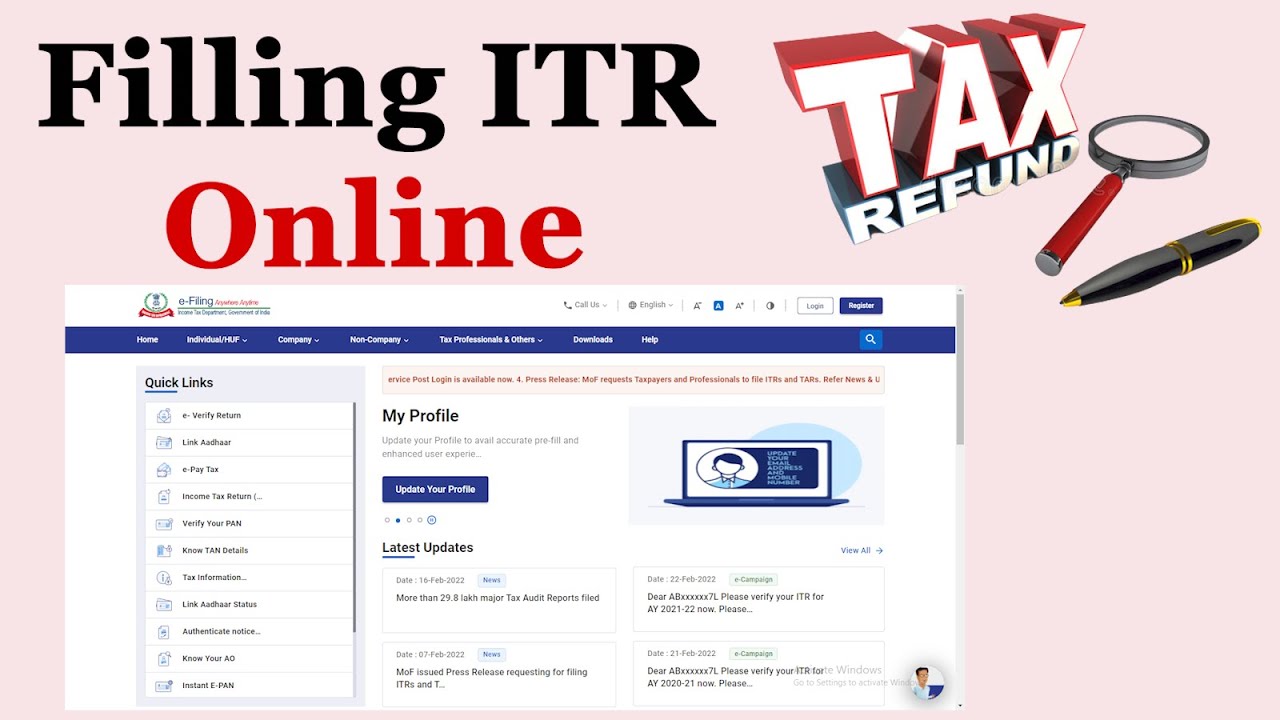
| 2 | e-File → Income Tax Returns → File Income Tax Return |
| 3 | Select AY 2026–27 (for FY 2025–26 income) |
| 4 | Select online filing mode |
| 5 | Select correct ITR form |
| 6 | Verify pre-filled salary, TDS, and personal details |
| 7 | Add income not pre-filled interest or capital gains |
| 8 | Apply deductions if using old regime |
| 9 | Review tax payable or refund due |
| 10 | Submit and download ITR-V acknowledgement |
| 11 | Verify within 30 days Aadhaar OTP takes 30 seconds |
Step 11 is the one most first-time filers miss. An unverified ITR is not a valid filing.
Data Security While Filing Online
Use only incometax.gov.in. Set a strong, unique password that is not the same as your email or social media.
The Income Tax Department never calls asking for OTP. Any such call is fraud. End it.
On shared computers, log out completely and clear browser cache after filing.
Common Mistakes First-Time Filers Make
Wrong bank account for refund. The IFSC and account number must be exact. Pre-validate your bank account in the portal before submitting.
ITR-1 when ITR-2 applies. Capital gains from mutual funds or shares rules out ITR-1. Check AIS it shows what the government already knows about your income.
Not verifying after submission. An unverified return is not a valid filing. Aadhaar OTP takes 30 seconds.
Waiting until July 31. Portal crashes every single year on deadline day. File before July 15.
Example Case Study
Fictional for educational purposes only.
Rahul Mehta, 26, a software developer in Pune, had Form 16, ₹12,000 interest income from SBI, and ₹8,000 in LTCG from mutual funds.
He checked AIS first all three income sources were already captured. He selected ITR-2 because of the capital gains (not ITR-1). Pre-filled data matched Form 16. He added interest income and verified capital gains.
Refund calculated: ₹3,200 excess TDS on interest. Pre-validated bank account, submitted, and Aadhaar OTP in 40 seconds.
What he got right: AIS check first, correct form, and verified immediately. Total: 35 minutes.
FAQs
Q1. What is ITR?
A declaration of total income, tax paid, and refund or liability for the year.
Q2. Who must file?
Those above the basic exemption limit and others in specific situations can verify at incometax.gov.in.
Q3. Documents needed?
PAN, Aadhaar, Form 16, Form 26AS, AIS, bank details, investment proofs.
Q4. Can I file online?
Yes, incometax.gov.in pre-fills most data.
Q5. Miss July 31?
Belated return possible by 31 December 2026 with ₹1,000–₹5,000 late fee. Losses cannot be carried forward.
Q6. How to verify?
Aadhaar OTP is the fastest, 30 seconds. Also, VC via banking or signed ITR-V by post.
Q7. Which ITR form?
Use the portal’s form selection wizard. ITR-1 is for simple salary, and ITR-2 is for capital gains.
Q8. Current rules?
incometax.gov.in only.
You need to file before July 31. You should verify the file immediately. It is an idea to keep the acknowledgement in a safe place where you will be able to find it when you need it two years from now. Keep the acknowledgement somewhere you will find it two years from now so you can look at your file and the acknowledgement at the time.
Looking for the latest updates on income tax, personal finance, government schemes, and financial guides? Visit BenefitsIndia.com regularly for trusted guides and timely updates.
About The Author