Suresh Pillai owns a Hero Splendor. He has for nine years. When he heard that a new fuel called E85 had launched in Delhi at ₹82 per litre nearly ₹20 cheaper than regular petrol his first question was the same as millions of other two-wheeler owners across India.
Can I use it on my bike?
The answer is no. This article will tell you why.
On June 5, 2026, which is World Environment Day, Union Petroleum Minister Hardeep Singh Puri opened India’s first E85 dispensing station at an Indian Oil outlet on Pusa Road in New Delhi.
This is when Maruti Suzuki showed off the Maruti Suzuki WagonR Flex Fuel, their flex-fuel passenger car. It made people who own vehicles think about some real issues with E85 and their own bikes and cars. People who own vehicles started to think about the E85 dispensing station and how it affects their own bikes and cars. The E85 dispensing station is a deal for people who own vehicles that run on regular fuel.
E85 is not a fuel upgrade that any vehicle can automatically switch to. It requires a specific kind of engine. And right now, the number of vehicles in India that actually support it can be counted on two hands.
So What Exactly Is E85?
The name gives it away. E85 is a mix of about 80 to 85 percent ethanol and 15 to 20 percent gasoline. For example, E20. The gasoline you have been using since April 2026. Has only 20 percent ethanol and 80 percent gasoline.
That is a massive jump in ethanol content. And it is not a jump most vehicles can handle.
India has been quietly increasing the ethanol percentage in its petrol for years. Blending was at 1.53% in 2014. It crossed 10%, then 15%, and by April 2026, E20 became the default fuel at petrol stations across the country. E85 is the next step in that same journey, but it is a much steeper step, and it comes with strict compatibility requirements that most of the country’s vehicle fleet does not currently meet.
Why Is the Government Doing This?
India spends enormous amounts of foreign exchange every year importing crude oil. Over 85% of the country’s crude requirement is imported. Every time global oil prices spike, as they did in May 2026, the country pays more, the rupee comes under pressure, and inflation follows.
Ethanol stands out. India is a producer of it. We use sugarcane, maize, and old grain to make ethanol. When fuel companies mix ethanol with petrol, India doesn’t have to buy as much crude oil from other countries and uses more of what our own farmers grow.
The government’s numbers are really interesting. If half of all bikes and cars could run on different fuels and use E85, we could need over 312 crore litres of ethanol every year. Farmers could earn around ₹12,403 crore more from selling ethanol. We could also save around ₹15,151 crore per year on exchange.
Whether those numbers fully materialize depends on adoption. But the direction of policy is clear India wants to grow its ethanol economy, reduce its oil import bill, and give domestic agriculture a new revenue stream at the same time.
Which Vehicles Can Actually Use E85?
This is where most people go wrong. E85 is not a stronger version of E20 that any modern car can handle. It needs a car called a flexible fuel vehicle or FFV. These cars are built to run on E85.
An FFV has a modified ECU that detects the ethanol content in the fuel and adjusts combustion accordingly. The fuel injectors are larger. The fuel pump is designed for higher flow rates. Seals and tubing throughout the fuel system are built from ethanol-resistant materials. Without all of these modifications, E85 will damage a standard engine over time. Sometimes quickly.
As of June 2026, the list of E85 vehicles available in India is really short.
When we talk about two-wheelers, Hero MotoCorp has come out with the Splendor+ Flex Fuel and HF Deluxe Flex Fuel. These bikes will be on sale in Delhi and some parts of Maharashtra from July 2026. The Suzuki Gixxer 250 SF Flex Fuel bikes cost around ₹6,000 more than the versions. Suzuki had already launched the Suzuki Gixxer 250 SF Flex Fuel at the 2025 Bharat Mobility Expo.
Now let’s talk about four-wheelers. The Maruti Suzuki WagonR Flex Fuel is the car in India that can run on flex fuel, and it is being sold to companies, not to people who want to buy it for themselves.
Tata Motors says they might have their flex-fuel car by the end of 2026. Toyota has shown us the Innova Hycross flex-fuel prototypes many times. There is a difference between just displaying something and actually being able to purchase vehicles that are compatible with E85, such as the Innova Hycross flex-fuel.
What Happens If You Put E85 in a Regular Petrol Car?
Do not.
A standard petrol vehicle, even a brand-new BS6 Phase 2 car designed for E20, is not built for E85. The fuel system components cannot handle the higher ethanol concentration over sustained use. The ECU cannot recalibrate itself for the very different combustion characteristics of an 85% ethanol blend.
Running E85 in such a vehicle can cause corrosion in the fuel lines, damage to injectors, and, over time, permanent engine issues. The vehicle manufacturer’s warranty will not cover damage resulting from use of incompatible fuel.
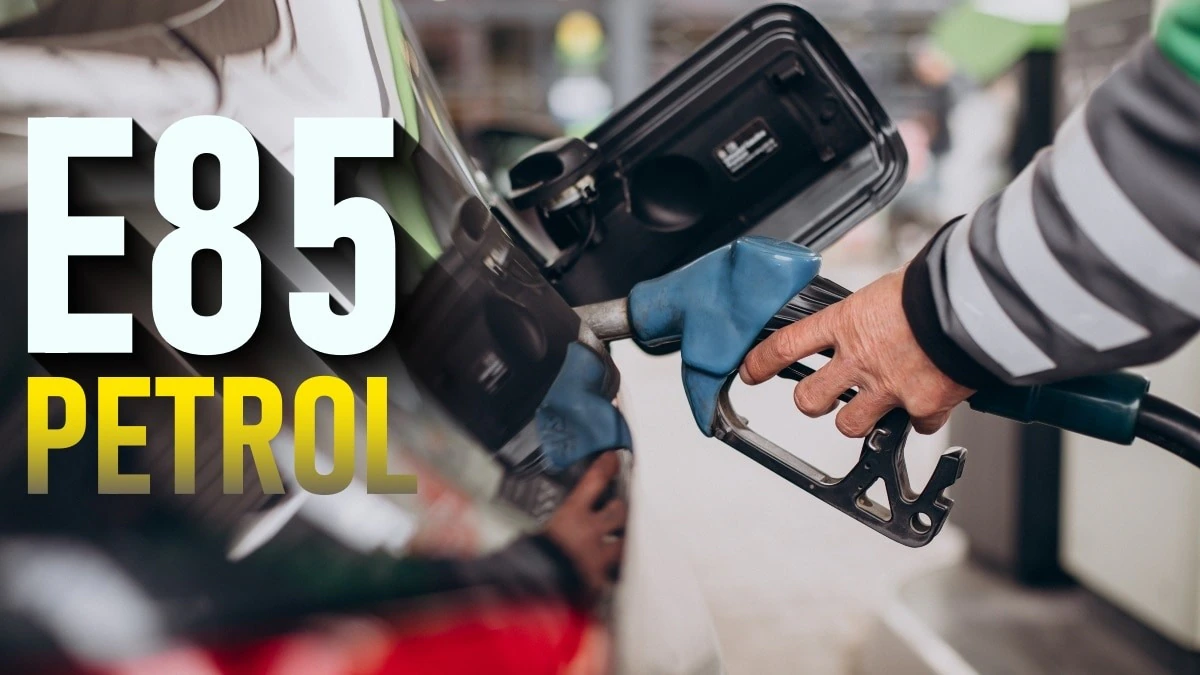
The pumps dispensing E85 carry distinct branding precisely to prevent accidental use. If you pull up to a pump, check what you are filling. E85 dispensers are marked separately from E20.
Is E85 Cheaper? The Real Math
At ₹82.12 per litre in Delhi, regular petrol costs less than E20 petrol at ₹102.12. Twenty rupees per litre is a saving.
There is something important to consider. Ethanol has more energy than regular petrol. It has 28 to 32 percent less energy. This means your car will go kilometers on a litre of E20 petrol.
Flex-fuel vehicles running on E85 can expect mileage to drop by around 25-35% compared to the same vehicle running on E20. So while the fuel costs ₹20 less per litre, you are filling up more often.
Let us think about an example. A Hero Splendor that runs on E20 fuel can go sixty kilometers on one litre of fuel. If we use E85 fuel in the bike, it can go forty to forty-five kilometers on one litre of fuel. We pay eighty-two rupees for one litre of E85 fuel and one hundred two rupees for one litre of other fuel, but the bike uses up the E85 fuel much faster.
The difference in the cost of running the bike per kilometer is real. It is not as big as the difference in the price of one litre of fuel. Whether or not using E85 fuel saves us money depends on how much cheaper it is at the fuel station near our place and how far the Hero Splendor bike can go on each type of fuel.
For now with E85 at ₹82 and E20 at ₹102 in Delhi, there is a modest saving per kilometer for FFV owners. If crude prices push E20 higher while E85 stays stable, the saving grows. If the price gap narrows, the efficiency penalty may cancel out most of the benefit.
The Bigger Picture for India’s Auto Industry
The E85 launch is a signal to vehicle manufacturers. The government has built the regulatory framework. The Bureau of Indian Standards has recognized E85 as a formal monofuel standard for flex-fuel vehicles. The first pump is working.
The infrastructure rollout has a timeline.
Here are the goals:
- 500 outlets by December 2026
- 5,000 outlets by the end of 2027
The rollout is on schedule so far, with the first pump operational.
That is the government’s commitment. The industry’s response will determine whether this fuel becomes mainstream or stays at the margins.
Hero MotoCorp has moved quickest two flex-fuel bikes are already in the market, with more models expected. Maruti Suzuki has the WagonR Flex Fuel. Tata and Toyota are watching and developing. As the pump network expands and consumer demand signals become clearer, more manufacturers will follow.
Brazil is the reference point the government keeps citing. Over 80% of light vehicles there run on flex-fuel technology. Getting to that point took decades of sustained policy, fuel availability, and consumer incentive. India is in the very early chapters of that story.
Before You Make Any Decision – Read This
If you already have a vehicle, you should look at your owner’s manual to see what kind of ethanol mix it can take. Most regular cars and bikes in India can handle E20. Some older vehicles can only take blends. You should not put E85 in any of them.
If you are buying a two-wheeler and you like the Hero flex-fuel model, think about the extra ₹6,000 it costs compared to how much you will save on each kilometer. Also see if there is a place to get E85 near where you fill up. Now there are only 48 places to get E85 in all of India. If you live far from one of those 48 places, the extra money for fuel does not help you.
If you are in the market for a new car and want flex-fuel capability, the honest answer right now is “wait.” The WagonR Flex is only going to commercial buyers. Private buyers will likely have more options by late 2026 or 2027 as Tata and others bring vehicles to market.
And if someone at a fuel station suggests you try E85 in your standard petrol vehicle to save money, walk away.
Where This Ends Up
The E85 launch is not a small thing. It is the opening of a new chapter in India’s fuel policy, one that connects farm income, import bills, greenhouse gas targets, and consumer choice in a single initiative.
But it is an early chapter. Forty-eight pumps in a country with over 90,000 fuel stations. A handful of compatible vehicles in a fleet of hundreds of millions. The infrastructure and the vehicle market both need to grow significantly before E85 becomes a real option for the average Indian driver.
The direction is set. The speed of travel is still uncertain.
If you have a car that can use kinds of fuel and there is a place near you where you can buy E85 fuel, you should try it out. You can do the math. See if it is a good idea for you. For people who do not have this kind of car, it is something to pay attention to over the year or two.
If you want to know what is happening with cars, what the government is doing, how fuel costs, new technology, jobs, and things the government is doing to help people, you should visit BenefitsIndia.com often. This website has information, detailed guides, and explanations that are easy to understand.
About The Author